Showing posts with label advertising. Show all posts

Wednesday, December 9, 2015

Why CBS shouldn't care about Colbert's ranking and why the traditional CPM model is broken

Take a gander at this somewhat concerning title below about Stephen Colbert's slip to 4th place after Seth Myers in the late night rating battle:

http://www.mediaite.com/uncategorized/colbert-slips-to-4th-place-in-late-night-race-beaten-by-seth-meyers-who-airs-one-hour-later/

Another very short analysis below:

Colbert's ratings can be attributed to several factors -


  • Colbert's divisiveness as a host (certainly not neutral on topics)
  • As an extension, CBS' likely trepidation as to letting him go back to his formerly bitey-er commentary style makes the divisiveness useless
  • Nerdiness factor that alienates both older and less educated viewers
  • Classiness factor that bores younger Youtube era viewers


On the other hand, I think CBS would be wrong in trying to pressure Colbert or threaten to cancel in any way while he catches his stride and can redirect any pressure coming from advertisers that want to push the traditional Cost-Per-Thousand(M) model to how valuable Colbert is to them out of 1 simple factor:

His viewers are likely a lot more valuable on an individual basis.

To put this into perspective, do the following fuzzy math in your head:

How many Wal-Mart shoppers are worth 1 George Lucas?
How many 13 year old Pew Die Pie subscribers are worth 1 Ivy League graduate?

It's a bit of an exaggeration, but you get the point.

Interestingly enough, the ever-evolving online CPC/CPM marketing and the databases associated with them will lead to an interesting change in how viewers/demographics are valued, and will lead to more diverse and quality programming across all media.

Hopefully the Discovery/History/TLC guys will understand this as well and go back to their roots.

[Cynical view below]

On the other hand, this will likely extend into more in-depth valuing of social media shares due to marketer's ever growing demand for more information (than they actually need), drive creation of more intrusive and annoying styles of digital marketing, and what should be a great thing for content creators will turn into something ugly and mutated past its intended application like most things.

C'est le vie.

Wednesday, June 18, 2014

What Brands Would Survive in a World Without Advertising? (Reddit Discussion)

Add this stuff to your next plain cheese pizza slice and you'll see why Sriracha has an international fanbase.

There was an interesting thread on reddit's /r/AskReddit (a main sub) yesterday:

If advertising was made illegal (print, TV, internet ads, etc. not the packaging), which products do you think would survive based on customer loyalty, quality, or word of mouth?


http://www.reddit.com/r/AskReddit/comments/28e1w4/if_advertising_was_made_illegal_print_tv_internet/

The results seem to match what I've been telling people for years: No matter how you dress it up, no matter how much you polish it, nothing really ever beats word of mouth and true value in the end.

Some of my favorite comments (copied as is):

Jiffy mix sells over 55% of all muffin mixes in the United States and they don't spend a dime on advertising.
user megobits

WD40
Ain't nobody seen an advertisement for WD40 but everyone's got a can in the shed.
user Einsatzkommando

The main cigarette brands. If putting death notices on packets doesn't stop people, no advertising at all certainly won't!
user TheWindBelow

Pretty much any type of doctor / physician. If I see an internist advertising on a billboard, I probably will be less likely to go see them -0 but if a friend tells me that doctor is good, that means the world to me.
Also probably colleges / universities. Again, the good ones wont advertise much and just survive on reputation.
user Best_Zyra_LAN

arizona drinks, they are very popular but i dont think ive ever seen a ad for them
user awesomo213

Q-Tips because the cheap ones will fuck up your ears.
user rwildhorseranch

That Sriracha sauce that everyone uses. That company has never advertised. Their product is popular because of word of mouth, and nothing else.
user ElDochart

Their product is popular because of taste in mouth, and nothing else.
user IJustNeedToMention in response to above Sriracha comment

My thoughts:
These are all good points, and I personally think there would be a simulataneous upsurge in quality local shops and as well as a strengthening of brand loyalty to existing market leaders who have stood the test of time.  

Tuesday, April 1, 2014

New Adwords Feature: AdBirds! Reach Out With Pay-Per-Cluck Advertising!

pay-per-cluck


I don't know about you guys, but I'm super excited to reach out to a targeted market with Pay-Per-Cluck advertising!

Clever Viagra Ad Concept - Vertical Billboard

advertising, marketing, funny
Does the billboard make you think of something in particular?
Nudge, nudge, wink, wink, euphemism, metaphor?

...Get  your mind out of the gutter.

Thursday, March 27, 2014

Facebook Prompts Remind You that FB "Cares About Your Privacy" :D

Does Facebook Suddenly Care About Your Privacy?

Article from TechCrunch:
http://techcrunch.com/2014/03/25/facebooks-privacy-checkups-remind-users-to-stop-posting-publicly/

Some blurbs from the article:

"Though a seemingly minor informational prompt, the addition arrives at a time when Facebook is facing increased competition with a bevy of mobile, social services offering more private sharing – WhatsApp being one which the company notably acquired for a mind-boggling $19 billion.

Earlier this month, Facebook also rolled out new private photo-sharing tools that offer an easier way for users to select specific people to share a photo album with via Facebook’s News Feed. The selector itself is reminiscent of Snapchat since it also lets you pick individual friends who can see your private photos."

"It’s also interesting to see Facebook shift its course to refocus on more private sharing in this post-Snowden era where users are beginning to feel more wary of the public nature of online sharing. Meanwhile, a new generation of users has been born into a world where their identities and private lives were already over-exposed by mom and dad while still in the womb and learning to crawl. It’s the perfect storm for a backlash against public socializing."


~~~~~~~~~~~~~~~~~~~~~~~

The Reality:
They just realized that by sharing your data with search engines they're bleeding value from their ad platform

:D

Tuesday, March 25, 2014

Basic PPC Advertising Reports Analysis - Dimension and Segmentation

The Top 5 Most Important Segments and Dimensions to Optimize Your Google Adwords Campaign


So, you've set up your first PPC campaign in Google Adwords, and have been A/B testing different keywords with varied results, settled on a set that seems to be working, and are now looking for new ways of optimizing your ROI from PPC.


No one can argue with the fact that keyword optimization is a must to successfully manage a campaign. But we also believe that if this is all you look at, you’re only scratching the surface of your potential.
When we analyze the performance of a PPC campaign, we must look at the data in a number of different ways to determine the real pain points and opportunities within a campaign. Below are a few reports we suggest you look at the next time you’re optimizing a PPC Search campaign in Google AdWords:

Device


You can find this report on the main ‘Campaign’ tab, under the ‘Segment’ drop down. This report is going to show you how your campaign is performing on Laptops & Desktops vs Mobile Devices vs Tablets with Full Browsers.

If your campaign isn’t performing on mobile devices you may want to consider adjusting your mobile bid modifiers to limit exposure and have your mobile site checked for errors.

Day of Week


You can find this report on the ‘Dimensions’ tab, under the ‘View:’ drop down. This report is going to show you how your campaign performs on the various days of the week. Depending on your type of business, you might perform better on certain days than others.

If your campaign isn’t performing as well on certain days of the week, go into your campaign settings and adjust your day parting strategy to limit exposure on those days.

Hour of the Day


You can find this report on the ‘Dimensions’ tab, under the ‘View:’ drop down. Similar to the Day of Week report above, this report is going to show you how your campaign performs during certain hours of the day.

For most outside of local late night brick and mortar establishments, the hours of midnight to 4am are generally unproductive. If your campaign isn’t performing during certain hours of the day, go into your campaign settings and adjust your day parting strategy to limit exposure on those hours.

Network 


You can find this report on the main ‘Campaign’ tab, under the ‘Segment’ drop down. This report is going to show you how your campaign is performing on Google.com vs Google’s Network of Search Partners, like AOL. If your campaign isn’t performing as well on Google’s Network, go into your campaign settings and exclude Google Search Partners.

Geographic 


You can find this report on the ‘Dimensions’ tab, under the ‘View:’ drop down. This report is going to show you how your campaign performs in various geographic locations.


  • If you are a local business, you might want to only show your ads within a strict geographic region. 
  • If you are a nationwide or international business, you might find you perform better in certain regions and less so in others. 
  • If either of the above circumstances are happening, go into your campaign settings and adjust your targeted location settings. 


Depending on your situation, you may need to add or exclude certain regions.


At the end of the day, when it comes to Pay Per Click, it’s our belief that you always want to focus your energy – and your money – in the areas of the campaign that have the greatest promise of generating a return. If you invest the time to analyze and optimize each of the above aspects of your campaign, we’d say you’re on the right path. Just remember to check on those keywords every now and then.

Monday, March 10, 2014

Cost vs Effectiveness of Various Media (Print vs Radio vs TV vs Online PPC)

HH Global, a Marketing firm has put together a clean presentation on Cost and Effectiveness for every 1000 people reached, and below are the pretty info charts they made.

Here's the full article: http://www.hhglobal.com/blog/the-most-cost-effective-advertising-platforms


Cost of Reach/1000 - CPM


Effectiveness of various mediums - Newspaper vs Magazines vs Radio vs Televison vs Online
Source: http://www.twistimage.com/blog/archives/what-type-of-advertising-has-the-most-influence/

The two graphs combined

Tuesday, December 17, 2013

How to Market Your Way to a Top 25 Paid Mobile App Game

A Case Study of Piston Game's iOS Success on the Apple Store


Here is a post from Reddit User and Piston Games member brainsolid explaining their success of their iOS game Gemibears. It is an excellent list of marketing advice that distills months and years of experience into a bite-sized piece and the thoughts applied here can be extended to any App, not limited to games.

~~~~~~~~~~~~~~~~~~~

We here in Piston Games just launched Gemibears for iOS and after few days break through to top paid 25 overall in US.

http://itunes.apple.com/us/app/gemibears/id471855200?mt=8

This was really hard and interesting, so I would like to share with you our experience. There are 10 steps to get top paid 25 overall in US:


1) Make a great game and prepare great marketing


You need to spend on marketing as many time as you spend on development. Bad app can be pulled to top by great marketing, but when your campaign will end — app will be dramatically dropped down. This is what you see every day in top free charts with lot of farms that makes rocket jump because of great marketing and falling to nowhere another day. So you must make great game.


2) Test your gameplay


But game must be great not just for you — because what you make is already great, otherwise you wouldn't do it, right? Every developer just love his game because it's like a child and sometimes you just not strict enough to your child. So test your game a lot — give it to your friends or even strangers. And don't ask anything — just look at their reactions and make conclusions about mistakes and advances.


3) Catch all bugs


 Test game on different devices and firmwares. The worst thing you can have is a great game with bad review, because of some bug. Don't release unfinished product. And have some support page, like getsatisfaction, so people will tell your about bugs not by App Store reviews, but on your support page.

And if you miss some bug — use expedited review. You can use it once a year, but it really helpful — about one day and update with fixes will be on App Store.


4) Don't make lite version


It's boring and player will have to pass through same levels in full version if he buy it. But you need free version for players who would like to try your game! So make something special — we call it Gemibears Mini. It's free prequel for Gemibears, it have completely different planets, levels and additional game mode — all these features are original and don't appear in paid version. Same way was made Trainyard Express and Hambo Begins. Different content for free is a best way to show your game and have positive response from players, because you don't cut anything from the game — you add something new to it.

Remember that your paid and free (not light!) versions — are separate products. Free will help you with promotion of paid, but you need to promote free somehow. So plan your marketing for both free and paid versions.


5) Cross promo and ad


Make cross promo with other cool games. Gemibears have promo screens, buttons and so on in different games from our friends. This is not about money, more about your connections. Send email with cross-promo proposition to games you like, or even travel to another city for meeting with their developers. Because support from other great games will give you lot of downloads.

Connect all your previous games by some cross-promo module. You can make in house solution or use something like chartboost — but 3rd party solutions are not flexible at all.
Use paid ad — but use it carefully. Buy iOS ad ONLY. No web, no magazines, videos or anything else outside device. You can buy installs for free app in chartboost or buy ad spot directly in Backflip, EA or Zynga games using Burstly, but be careful planning your budget.


6) Make something that will generate new users from inside of your game


We have twitter community in Gemibears and Facebook connect in Gemibears Mini. Both give an option to attract new players, because community is always great idea and attract new people, and by connecting your friends to the game you can gain additional content.


7) Make all marketing efforts in one day


Don't spread it for month or even week. We release Gemibears few days before all marketing and have no downloads at all. But after using all marketing that we prepare in just 3 days — top 25 occupied!


8) Icon, screenshots and trailer


You need a genius icon. Most of people make decision about buying or not your game just by looking at it icon. We make about 26 different variants of Gemibears icon before we considered it good enough. Great, to be honest.
Other really important part — App Store screenshots. Actually, they aren't just screenshots — they are banners. Most of people don't read description, so take each screen and tell about key game features on it. Be brief and persuasive. Not "unique gameplay", but "match-2" — this is truly unique!
Official trailer. If you don't make it — some youtube teen will record video from shaking hands and all people will see the game as it looks at this video.

9) After release buzz


Don't underestimate any additional free buzz that you can make. Register your game in Facebook App Center if you have any fb functionality. Submit your icon (it's must be great, do you remember?) to iOS icon gallery sites. Make TouchArcade forum post — in upcoming section before release, in discussions right after or even make some contest!

Don't expect Apple feature on App Store. You can't control featuring process, so concentrate on making great game and marketing.

Don't expect Press will admire your game for first time, even if you have a great game. Press and blogger like success stories, so you will have press after success, not before it.

But you have to write to everyone. Make not just text letter, but some custom html template or at least image banner for header of the letter. This way we have TUAW game of the week for our previous The Screetch game. They ignore our text letter with promocode, so we make nice-looking picture, send a latter again and — it works!

10) Write useful post on Reddit!


~~~~~~~~~~~~~~~~~~~~~~~~~

The thing I find the most interesting is that they spend a large chunk on advertising in one big go in a highly targeted way - bid to spend as much as fast as possible in a short period of time dedicated to users on Apple iOS mobile devices - a PPC approach that embraces the fleeting popularity of mobile games. Brilliant.

Saturday, December 7, 2013

How to Set Up Phone Ad Extensions & Protect Yourself From Robo-Dialers

How to Set Up Phone Number Ad Extensions on Adwords & Benefits for Businesses


Pictured: Not how robocalls work.

First, why people use call extensions and Google's sales pitch:

Why you'd use it


  • Make it easy for mobile users to call you when they're on the go.
  • Easily add your phone number to ads across an ad group or an entire campaign.
  • Schedule call extensions to show when your business is ready to take calls.
  • Understand the effectiveness of your ads by counting the calls that lead to conversions. Learn more about call conversions.
  • Get a higher clickthrough rate. AdWords advertisers have typically seen a 6-8% average increase in clickthrough rate after adding call extensions.

Watch this video from Google on how to set one up:


Now, these extensions are wonderful for many businesses to get highly relevant hits. A very specific example: a restaurant sets up a phone extension on a ad targeted by the following

  1. Within a 5 mile radius of their location
  2. Mobile devices 
  3. Scheduled between 10AM to 2PM & 5PM to 9PM

Now, all people in a walking distance looking for that style of restaurant on a whim during lunch and dinner hours are given a heads up by Adwords that this business might be the right pick for them, and they can just tap the number shown on the ad to set up a reservation with ease. A highly targeted campaign that will only use up the advertising budget to a likely potential customer, so you can see the obvious advantages to using these extensions.

Whether you are a restaurant or a lawyer's office, having the local business information and phone number listed adds both transparency and something to act upon, so an extension might be a good way to supplement your existing Adwords PPC strategy.

How to Protect your Adwords budget from Robodialers 


Unfortunately, there are plenty of unscrupulous uses of search engines, and one of them is to have a computer program scrape search results for phone numbers and dial them. If your ad is showing for a particular keyword the program is targeting, the robodialer may click through and call your number to send marketing information or check who is on the other end. This action will count as a click in Adwords, and may start draining your advertising budget.

These two tips are not foolproof nor are they effortless, but may be necessary to protect your advertising investment from worthless clickthroughs from annoying telemarketers.

  1. Record & Report to Google

    If you are recording the calls (many of my clients do through a call tracking software), provide the recordings as evidence and report the invalid clicks.
    Explanation of Invalid Clicks
    Google's protection against invalid clicks
  2. Get on the Do Not Call Registry and Private Do Not Call Lists

    This step will just make it less likely that a worthless click will go through:

    The National DNC list: https://www.donotcall.gov/‎

    The National Do Not Call list prevents companies that do not have a business relationship with you from calling you. This isn't foolproof, so when a company calls you, you should get into their company's do not call list as well.

  3. Some additional details about the Do Not Call Registry and the TCPA:

    If you are on the National DNC list You can still get telemarketing calls! If you have a business-client relationship (say a Bank of X checking account) Bank of X can call you about products and services. You can also still receive political and non-profit calls.

    So when you get a telemarketing call on behalf of a company and asked to be put on their do-no-call list (a method that only works for respectible call centers), you'll be put on that client's do-not-call list. This means that you won't get any calls on any offers from that client. However, since most call centers have anywhere from 5-20 different clients at once, you're most likely still in the system for at least one of those other lists.

    A better way to deal with that is to speak to a supervisor, ask them what call center they're calling from, and request to be put on the call center's do not call list. This disables the call center from calling you.

    According to TCPA (telephone consumer protection act.), telemarketers cannot:

    Call before 8am or after 9pm
    Call your cell phone
    Hide who they are or who they're calling on behalf of
    Call you if you're on the national do not call list call with a pre-recorded message (unless within the first 4 seconds of a call, the rep must reveal who they are, where they're calling from, and who they're calling on behalf of.)

    If a telemarketer breaks any of these rules, you can sue them then add the $500 fine to your Adwords budget :)


I hope this article helps, and despite the one potential drawback of encouraging robodialing, phone ad extensions are still incredibly useful to a complete PPC strategy, and as shown above, the issue can be dealt with.

Friday, November 29, 2013

Bad Design Might Drive Away Customers for Small Businesses and Freelancers

Why Clean Design is Important for Small Businesses and Freelancers: A relatively short rant pointed at strawmen explaining why cluttered design might drive away business. 


Just a fake logo for a fake company I made up in my head.
Follows my personal best practices for logo design.

Logo and website design is something that is often overlooked by new business owners as it does not pertain to the core of the business, but can mean the difference between a walk-in versus a walk-by because of preconceived notions about quality.

Before we go on, let's see two common examples of bad design from local businesses:

1. The Cluttered Local Coupon

A classic - the local ad done by someone who just learned how to use Photoshop. You've likely seen this one in your local penny saver/coupon book. There are several things that are technically good - the logo is actually clean, and a visible offer, call to action, and contact information. On the other hand... just look at it. 
Despite the fact that house painters don't necessarily need to be professional artists to do their jobs properly, the connotation of working with paint combined with the terrible mismatched design may provide enough cognitive dissonance to make a potential customer think twice about hiring them. 
Also, I get that SEO consultants usually stress the need for Twitter and Facebook, but I just find it silly in cases like this. Really no need to put it in the ad.


2. The Outdated Local Business Website


On a personal level, I know that only a truly experienced freelance Linux admin would have this appreciation of spartan design, but once again, many end customers might not understand that. This example also has good things going for it: Clear info and uncluttered design - unfortunately, the design is outdated by about 20 years. 
The logo looks like it was pulled from MS Word clipart, and all of the components of the webpage just are not themed out and looks disjointed.


So, with these extreme examples of poor design sensibilities in mind, I urge any small business owner to read up on logo design with printing in mind, then look back at how they present themselves online or in real life. When you are competing against bigger competitors with more resources, a simple, relatively small investment like a clean and clear logo and web presence might be just the leverage needed to make the sale.


Rabbit Design Philosophy and Examples: http://www.r4bb1t.com/p/design.html
Simple Small Business Website Package: http://www.r4bb1t.com/p/website-design.html

Thursday, November 28, 2013

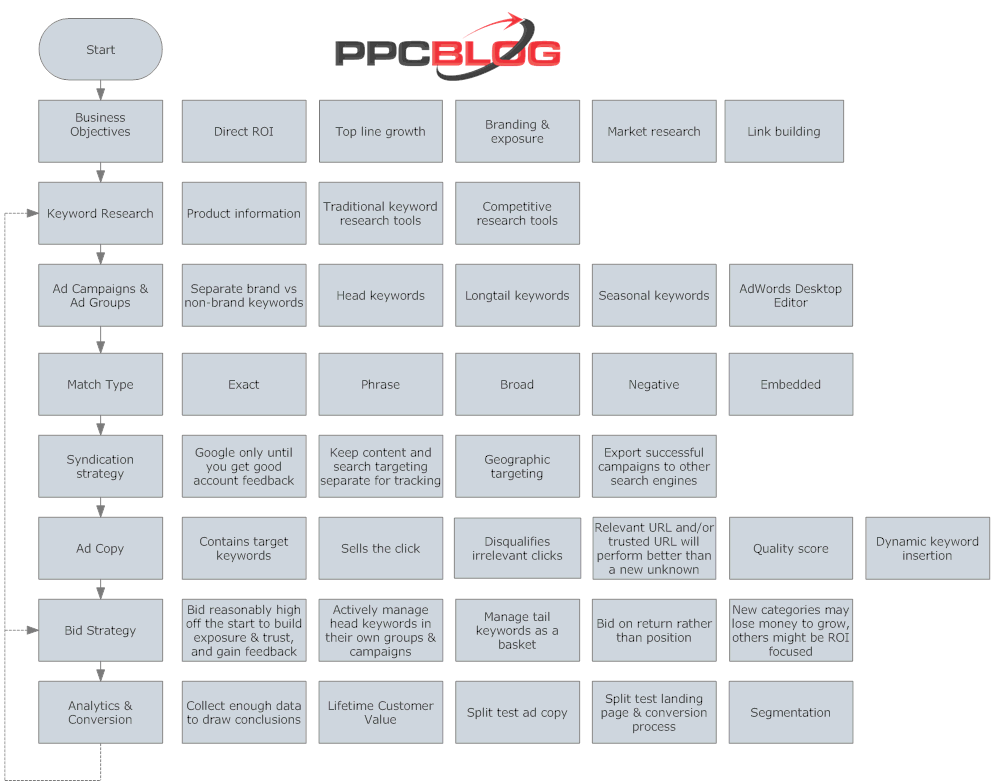
Simple But Effective PPC Flowchart

Not really sure why it's a GIF, but ok.
This flowchart from PPC Blog does a pretty decent job of outlining the implementation and refinement of a Pay-Per-Click Campaign.

Left side is flow from top to bottom, right is purpose and details. 

Roughly translates into:

  1. Start by defining Business Objectives and the expectations and needs from PPC advertising
  2. Do Keyword Research by tapping into available information and keyword tools
  3. Build initial Ad Campaigns & Groups based upon targeted demographics and relevant keyword groupings
  4. Define Match Type based upon range of relevant searches for targeted keywords
  5. Create Syndication Strategy for additional targeting methods and other search engines
  6. Write high quality Ad Copy to attract relevant attention and improve Quality Score
  7. Manage Bid Strategy based upon needs and budget
  8. Analyze your results, and use data to refine Keyword Research and Bid Strategy

This picture is a bit outdated, because it doesn't take into account Remarketing (targeting people who have already visited your site), but is still a solid flowchart.


Tuesday, November 26, 2013

Brief History Digital Age Advertising and Modern Web Marketing

A Brief History of Advertising in the Digital Age and some Thoughts on Modern Web Marketing

A brilliant post from reddit user & marketing guru over at VOIP startup 2600Hz, J2600:

First, there was SPAM. The DEC computer company sent out some SPAM over the ARPAnet back in the day, and thus began the torrent of abuse we all suffer from to this day.

After marketers realized SPAM didn't work (well some of them anyway), the next platform for battle was the web. But how to address this new dynamic audience? The first banner ad was from AT&T and essentially linked folks to museums all over the world (essentially demoing how the internet could narrow space and time). This ad had a whopping 44% click through rate, and for those of you who don't know, that's high, very high.

Originally, ads were sold with a suitcase. Sites had a set of inventory, and like traditional media businesses, that's how they sold. Yahoo, to this day, has an army of account managers gleefully cold calling the fortune 500 daily in an attempt to sell more space. If one had to articulate the difference between Yahoo and Google, it is a cultural difference. Yahoo was, and still is, a sales driven culture, whereas Google is all about the engineers. What do we know about most engineers? They don't like talking to peasants, and thus Yahoo sells with a briefcase and Google distributes through an online portal. If anyone asks you to articulate why Yahoo lost to Google even though Yahoo was first, it was because Google automated where Yahoo brute-forced with more salespeople. The moral is that payroll is always your highest cost.

So we're up to the point of automated ad acquisition on the Internet. People could buy ads, but then double-click came along and said, 'You can buy ads everywhere and control them!', which basically was an admission of the one true fact of online ads: Supply outpaces demand.

In online advertising, there is always a LOT more supply than demand. There are many more people trying to sell adspace than there are people that want to buy it. One might assume, naturally, that this would become a buyers market, but keyword based advertising is actually a seller's market. Adwords, for example, is really Google telling you how much you have to pay for an impression, and that doesn't reflect the underlying reality of our world. Again, supply > demand therefore the buyer should set the price. Even if you could buy based on audience or location and not keyword, you would still be paying for impressions that aren't actually valuable (people who don't have the faintest clue who you are will see your brand and that may or may not be valuable to you.

Well, if all of the search space is owned by Google, you sort of have to play ball right? That was true until the advent of retargeting.

Basically retargeting works like this:
  • User hits your site
  • User gets cookie'd
  • Anywhere they go that is part of the ad network, an auction takes place
  • The auction bidders are advertisers who bid based on the cookies a user has
  • Some people bid on generic cookies like "user is 25-40 years old" or "user likes red sports cars" but retargeting is basically saying "I only want to bid on people that've already been to my website"
  • Generic cookie folks are willing to pay a certain price for an impression if enough characteristics match up, but retargeting is always willing to pay the same price for the people who've been cookie'd
  • So while the page is loading, hundreds (thousands?) of advertisers are bidding on the ad you'll see
  • One the bidding is won, the ad is displayed
Almost all of those steps happen in less than half a second, and it's pretty incredible to conceptualize how complex the infrastructure that supports our advertising addiction has become.

So, let's talk, from a high level, about where to use the basic ad forms:

PPC: Pay per click ads are cool for branding. If you want people to see your brand, they work great, but they're basically spray and pray. If you're just starting out, don't go through the main channels like adwords as you'll burn your budget rather quickly. Consider alternative channels like Reddit or Stumbleupon as sources of relatively cheap traffic. I don't see a lot of value in PPC today.

Banner Ads: Private placement banner ads are still good, but you have to be tactical about purchasing them because they're not usually cheap. You can use an aggregation service if you have the volume, but this should be, IMHO, surgical. For example, at 2600hz, we've considered purchasing banner ad space on multiple Sysadmin blogs through direct relationships with their authors.

Retargeting: In my humble opinion, this is the only form of online advertising still worth a damn. You can follow people around the Internet, but only the people that already know who you are. It's glorious. The downside? Retargeting will eat your budget and fast. Remember the supply and demand problem? Because retargeting only cares that your customer went to your site, the places they display ads are different than say adwords which only displays on google searches. If you use retargeting, your customers will see your logo and they will see it all over the place.

My prescription, for Enterprise SaaS startups is to pour on the Retargeting and leverage a few surgical banner ads. I don't believe you should be using any sort of paid online advertising if your customer lifetime value is less than $50 as you'll be unlikely to ever break even. I believe online advertising can be a profitable channel for your business, but only if you are judicious about its usage. I've seen so many people burn through cash, it's crazy.

Remember also, cost per click is a relative term. If you relate it to your end goal, it's more reasonable. if you customer is worth $50, it's hard to justify paying more than $.50 per click, but if they have a value of $500, a CPC of $1.50 or even $4.00 could be justifiable. It all comes back to the business use case.

Do you have questions and PPC or other ad units? Drop'em in the comments below and I'll do everything I can to answer.

Curious about the history of ads? This is where I got most of my info: http://www.adpushup.com/blog/the-history-of-online-advertising/


~~~~~~~~~~~~~~~~~~~~~~~~~~~~~~~~~

Rabbit notes:

I do like the fact that he points out trying to use Adwords without knowing the ins and outs will have you burn through cash quickly, and suggests considering interest-targeted channels like Reddit Ads and StumbleUpon's Paid Discovery. 

A side note about Reddit ads - while there are a lot of factors that influence the success of Reddit ads, it is worth mentioning that it is one of the few ad networks that are generally whitelisted and may reach users who use Ad-blocking software - something to consider if the audience you want to reach is tech-savvy.