I don't know about you guys, but I'm super excited to reach out to a targeted market with Pay-Per-Cluck advertising!
Showing posts with label adwords. Show all posts
Tuesday, April 1, 2014
Tuesday, March 25, 2014
Basic PPC Advertising Reports Analysis - Dimension and Segmentation
The Top 5 Most Important Segments and Dimensions to Optimize Your Google Adwords Campaign
So, you've set up your first PPC campaign in Google Adwords, and have been A/B testing different keywords with varied results, settled on a set that seems to be working, and are now looking for new ways of optimizing your ROI from PPC.
No one can argue with the fact that keyword optimization is a must to successfully manage a campaign. But we also believe that if this is all you look at, you’re only scratching the surface of your potential.
When we analyze the performance of a PPC campaign, we must look at the data in a number of different ways to determine the real pain points and opportunities within a campaign. Below are a few reports we suggest you look at the next time you’re optimizing a PPC Search campaign in Google AdWords:
Device
You can find this report on the main ‘Campaign’ tab, under the ‘Segment’ drop down. This report is going to show you how your campaign is performing on Laptops & Desktops vs Mobile Devices vs Tablets with Full Browsers.
If your campaign isn’t performing on mobile devices you may want to consider adjusting your mobile bid modifiers to limit exposure and have your mobile site checked for errors.
Day of Week
You can find this report on the ‘Dimensions’ tab, under the ‘View:’ drop down. This report is going to show you how your campaign performs on the various days of the week. Depending on your type of business, you might perform better on certain days than others.
If your campaign isn’t performing as well on certain days of the week, go into your campaign settings and adjust your day parting strategy to limit exposure on those days.
Hour of the Day
You can find this report on the ‘Dimensions’ tab, under the ‘View:’ drop down. Similar to the Day of Week report above, this report is going to show you how your campaign performs during certain hours of the day.
For most outside of local late night brick and mortar establishments, the hours of midnight to 4am are generally unproductive. If your campaign isn’t performing during certain hours of the day, go into your campaign settings and adjust your day parting strategy to limit exposure on those hours.
Network
You can find this report on the main ‘Campaign’ tab, under the ‘Segment’ drop down. This report is going to show you how your campaign is performing on Google.com vs Google’s Network of Search Partners, like AOL. If your campaign isn’t performing as well on Google’s Network, go into your campaign settings and exclude Google Search Partners.
Geographic
You can find this report on the ‘Dimensions’ tab, under the ‘View:’ drop down. This report is going to show you how your campaign performs in various geographic locations.
- If you are a local business, you might want to only show your ads within a strict geographic region.
- If you are a nationwide or international business, you might find you perform better in certain regions and less so in others.
- If either of the above circumstances are happening, go into your campaign settings and adjust your targeted location settings.
Depending on your situation, you may need to add or exclude certain regions.
At the end of the day, when it comes to Pay Per Click, it’s our belief that you always want to focus your energy – and your money – in the areas of the campaign that have the greatest promise of generating a return. If you invest the time to analyze and optimize each of the above aspects of your campaign, we’d say you’re on the right path. Just remember to check on those keywords every now and then.
Labels:
advertising,
adwords,
analytics,
bid strategy,
big data,
dimension,
google,
keywords,
marketing,
online,
ppc,
search engine,
segmentation,
top
Thursday, February 27, 2014
Why Socially Adept and Knowledgable Introverts Might Have the Best Traits for Modern Sales/PPC Managers
Extroverts are traditionally the ones to be considered to be the best marketers - they are capable of having conversations with others, and so, were able to go in, schmooze the manager up to the owner, then make the sale. They could bully a person into adding that extra option on their new car. They could call a business and convince them to use your product... Then search engines had to come along and flip the entire marketing industry on it's head.
Thanks to the internet and how it's changed economies and societies in such a short time, I believe that the best salesmen of the near future will be Introverts rather than Extroverts, but only the ones who can understand/empathize with their target end user.
Just to clear the air, I'm going to go ahead and say that most of the people claiming to be introverts might just be lying to themselves, because you know, being extroverted is so passe. I actually cringed writing the end of that last sentence.
Fictional Example Time:
(Just bear with me for the following - there are points being made, I swear.)
You're a business owner in the late 80's hiring someone to drive sales of your Doohickey (Trademarked) over the phone and in person to distributors and retailers. You put up a listing in the local Penny-Saver -
Only two people show up three days later, partially because there was an accident with the Penny-Saver van (Why do they let the town drunk drive the delivery van?!), and the issue that you bought advertising space in only got delivered to the less popular grocery stores in town that week. Good Lord! Only if there was a paperless delivery system that could be magically accessed whenever for this sort of thing. But enough with the crazy talk, let's get to the candidates.
Larry shows up in a button down and jeans, seems polite enough and answers all of your questions in a thoughtful manner with good questions of his own, but stutters a little bit through his interview.
Then Joe shows up dressed in a Brooks Brothers suit, gives you a knuckle-popping handshake and a big grin, and answers all of your questions enthusiastically, but keeps talking about himself and why he's the best darn salesman to have ever walked this earth and never asks a single question.
"Well," you think, "Larry seems like a nice kid, but he couldn't go in and close a sale to save his life. Joe can push a conversation towards a sale, or at least he tells me he can. Too bad he has the personality of a cheese grater."
You go out to the waiting room and give Joe the sales position but you at least take Larry out for a beer because you feel he would be pleasant to have a conversation with.
While sipping your beer, you muse about what a ridiculous situation this was and a small voice in the back of your head wonders why you didn't just try to wait at least a couple days for more realistic candidates before making the decision like a sane person. But as it turns out, Larry is a huge fan of those new-fangled "microbrews" that started getting popular, just like you! So you start talking and buy a couple more rounds, then have too many beers with Larry, feel bad for him, and give him a temp job making your print ads because he at least has a background in art from high school.
This is the story of many introverts looking for a job in marketing even now.
Real fast, a review:
Introverts: Need time alone after social interaction
Extroverts: Need social interaction after time alone
Notice that being awkward and socially inept isn't in the introvert description? Because it isn't. You can be a socially adept introvert, or a socially inept extrovert. It's just that the inverse set is a bit more common noticed.
Socially Adept Introvert means that they aren't completely ignorant of social norms and human emotion - this is important because one still needs to understand the psyche of the end user and the stage of the buying cycle they are in as well as the things they value in the product they are searching for to pique interest and close the sale.
The key to this argument is in the previous sentence: "they are searching for."
THEY are SEARCHING for.
they SEARCHing.
SEARCH.
When Joe the Fictional 80's Salesman goes into a business and asks for a minute of time to tell the manager or owner about the Doohickeys, Joe is trying to get them to listen. Joe is trying to aggressively push in and get his pitch in, stir up interest, and make the sale before they have a chance to say no or a competitor catches their eye and robs him of the opportunity.
With the internet, Modern Joe is still be useful in sales, but mainly be there to close the sale on someone who was directed to him via a web search result, ready to hear about the Doohickey he has to offer, the path to the sale all planned out by Modern Larry.
With Search PPC advertising like Adwords, you're aiming to get the attention of someone who might be ready to hear your message because the person askedthe almighty knowledge machine Google about something related to what you're selling. They search, the Adwords algorithm takes into account your campaign info, weighs it against your competitors, and hopefully, you catch their attention and close the sale, possibly without a second of human interaction needed.
Take in/Predict the energy of the customer who is reaching out to you, and redirect the force into your planned sales funnels.
This is marketing Judo. (Aikido, if you dislike contact sports)
To do this, the person aiming to make the sale must have some level of these three characteristics:
Patience - The ability to wait for the consumer to come to them
Empathy - The ability to anticipate why the consumer would come to them
Creativity - The ability to impress the consumer who has come to them
From personal experience, I have found these particular traits most common in those I label Social Adept Introverts, and if you combine this with a want to study and learn, then you have the best characteristics for the modern marketer/PPC manager.
Disagree? Comment below.
Thanks to the internet and how it's changed economies and societies in such a short time, I believe that the best salesmen of the near future will be Introverts rather than Extroverts, but only the ones who can understand/empathize with their target end user.
Just to clear the air, I'm going to go ahead and say that most of the people claiming to be introverts might just be lying to themselves, because you know, being extroverted is so passe. I actually cringed writing the end of that last sentence.
Fictional Example Time:
(Just bear with me for the following - there are points being made, I swear.)
You're a business owner in the late 80's hiring someone to drive sales of your Doohickey (Trademarked) over the phone and in person to distributors and retailers. You put up a listing in the local Penny-Saver -
"SALESMAN WANTED WITHIN THE WEEK!
Needs the Gift of Gab and the Drive of a Bull!"
Only two people show up three days later, partially because there was an accident with the Penny-Saver van (Why do they let the town drunk drive the delivery van?!), and the issue that you bought advertising space in only got delivered to the less popular grocery stores in town that week. Good Lord! Only if there was a paperless delivery system that could be magically accessed whenever for this sort of thing. But enough with the crazy talk, let's get to the candidates.
Larry shows up in a button down and jeans, seems polite enough and answers all of your questions in a thoughtful manner with good questions of his own, but stutters a little bit through his interview.
Then Joe shows up dressed in a Brooks Brothers suit, gives you a knuckle-popping handshake and a big grin, and answers all of your questions enthusiastically, but keeps talking about himself and why he's the best darn salesman to have ever walked this earth and never asks a single question.
"Well," you think, "Larry seems like a nice kid, but he couldn't go in and close a sale to save his life. Joe can push a conversation towards a sale, or at least he tells me he can. Too bad he has the personality of a cheese grater."
You go out to the waiting room and give Joe the sales position but you at least take Larry out for a beer because you feel he would be pleasant to have a conversation with.
While sipping your beer, you muse about what a ridiculous situation this was and a small voice in the back of your head wonders why you didn't just try to wait at least a couple days for more realistic candidates before making the decision like a sane person. But as it turns out, Larry is a huge fan of those new-fangled "microbrews" that started getting popular, just like you! So you start talking and buy a couple more rounds, then have too many beers with Larry, feel bad for him, and give him a temp job making your print ads because he at least has a background in art from high school.
This is the story of many introverts looking for a job in marketing even now.
Real fast, a review:
Introverts: Need time alone after social interaction
Extroverts: Need social interaction after time alone
Notice that being awkward and socially inept isn't in the introvert description? Because it isn't. You can be a socially adept introvert, or a socially inept extrovert. It's just that the inverse set is a bit more common noticed.
Socially Adept Introvert means that they aren't completely ignorant of social norms and human emotion - this is important because one still needs to understand the psyche of the end user and the stage of the buying cycle they are in as well as the things they value in the product they are searching for to pique interest and close the sale.
The key to this argument is in the previous sentence: "they are searching for."
THEY are SEARCHING for.
they SEARCHing.
SEARCH.
When Joe the Fictional 80's Salesman goes into a business and asks for a minute of time to tell the manager or owner about the Doohickeys, Joe is trying to get them to listen. Joe is trying to aggressively push in and get his pitch in, stir up interest, and make the sale before they have a chance to say no or a competitor catches their eye and robs him of the opportunity.
With the internet, Modern Joe is still be useful in sales, but mainly be there to close the sale on someone who was directed to him via a web search result, ready to hear about the Doohickey he has to offer, the path to the sale all planned out by Modern Larry.
With Search PPC advertising like Adwords, you're aiming to get the attention of someone who might be ready to hear your message because the person asked
Take in/Predict the energy of the customer who is reaching out to you, and redirect the force into your planned sales funnels.
This is marketing Judo. (Aikido, if you dislike contact sports)
To do this, the person aiming to make the sale must have some level of these three characteristics:
Patience - The ability to wait for the consumer to come to them
Empathy - The ability to anticipate why the consumer would come to them
Creativity - The ability to impress the consumer who has come to them
From personal experience, I have found these particular traits most common in those I label Social Adept Introverts, and if you combine this with a want to study and learn, then you have the best characteristics for the modern marketer/PPC manager.
Disagree? Comment below.
Tuesday, December 10, 2013
How to see keywords users typed, not keywords you bid on, in Analytics or Adwords
Adwords Tips: How do you see keywords users typed, not keywords you bid on, in Analytics or Adwords Campaign Manager?
As far as most new users can tell, Google only shows them how many people search for a keyword you have bid on, it doesn't show them exactly what the user searched for. If the advertiser goes to the Keywords > Details > All list in Adwords, it doesn't show all of the searches.
For example, if they search for "where can I drink Imperial Honey Stout", and they click on an ad triggered by the broad term "Imperial Honey Stout", the advertiser can easily see "Imperial Honey Stout" triggered an ad, but is there any way to see that the user searched for "where can I drink Imperial Honey Stout"?
This is just a matter of digging slightly deeper into either Adwords or Analytics
Matched Keyword Query in Adwords
In Google AdWords,
Go to the Keyword tab
Click the gray "Details" button
Under Search Terms choose "All"- This shows the exact phrases people searched for which triggered your ads, including searches that did not generate any clicks.
Matched Keyword Query in Analytics
In Google Analytics
Acquisition > Adwords > Matched Search Queries
Change Secondary Dimension to Keywords - This shows the term searched for against the keyword that triggered the ad.
e.g.
Matched Search Query = where can I drink Imperial Honey Stout
Keyword = Imperial Honey Stout
Adwords and Analytics will need to be linked.
Labels:
adwords,
analytics,
bid strategy,
campaigns,
keywords,
marketing,
matched search,
ppc,
sem,
tips
Saturday, December 7, 2013
How to Set Up Phone Ad Extensions & Protect Yourself From Robo-Dialers
How to Set Up Phone Number Ad Extensions on Adwords & Benefits for Businesses
![]() |
| Pictured: Not how robocalls work. |
First, why people use call extensions and Google's sales pitch:
Why you'd use it
- Make it easy for mobile users to call you when they're on the go.
- Easily add your phone number to ads across an ad group or an entire campaign.
- Schedule call extensions to show when your business is ready to take calls.
- Understand the effectiveness of your ads by counting the calls that lead to conversions. Learn more about call conversions.
- Get a higher clickthrough rate. AdWords advertisers have typically seen a 6-8% average increase in clickthrough rate after adding call extensions.
Watch this video from Google on how to set one up:
Now, these extensions are wonderful for many businesses to get highly relevant hits. A very specific example: a restaurant sets up a phone extension on a ad targeted by the following
- Within a 5 mile radius of their location
- Mobile devices
- Scheduled between 10AM to 2PM & 5PM to 9PM
Now, all people in a walking distance looking for that style of restaurant on a whim during lunch and dinner hours are given a heads up by Adwords that this business might be the right pick for them, and they can just tap the number shown on the ad to set up a reservation with ease. A highly targeted campaign that will only use up the advertising budget to a likely potential customer, so you can see the obvious advantages to using these extensions.
Whether you are a restaurant or a lawyer's office, having the local business information and phone number listed adds both transparency and something to act upon, so an extension might be a good way to supplement your existing Adwords PPC strategy.
How to Protect your Adwords budget from Robodialers
Unfortunately, there are plenty of unscrupulous uses of search engines, and one of them is to have a computer program scrape search results for phone numbers and dial them. If your ad is showing for a particular keyword the program is targeting, the robodialer may click through and call your number to send marketing information or check who is on the other end. This action will count as a click in Adwords, and may start draining your advertising budget.
These two tips are not foolproof nor are they effortless, but may be necessary to protect your advertising investment from worthless clickthroughs from annoying telemarketers.
- Record & Report to Google
If you are recording the calls (many of my clients do through a call tracking software), provide the recordings as evidence and report the invalid clicks.
Explanation of Invalid Clicks
Google's protection against invalid clicks - Get on the Do Not Call Registry and Private Do Not Call Lists
This step will just make it less likely that a worthless click will go through:
The National DNC list: https://www.donotcall.gov/
The National Do Not Call list prevents companies that do not have a business relationship with you from calling you. This isn't foolproof, so when a company calls you, you should get into their company's do not call list as well.
Some additional details about the Do Not Call Registry and the TCPA:
If you are on the National DNC list
You can still get telemarketing calls! If you have a business-client
relationship (say a Bank of X checking account) Bank of X
can call you about products and services. You can also still receive
political and non-profit calls.
So when you get a telemarketing call on behalf of a company and asked to be put on their do-no-call list (a method that only works for respectible call centers), you'll be put on that client's do-not-call list. This means that you won't get any calls on any offers from that client. However, since most call centers have anywhere from 5-20 different clients at once, you're most likely still in the system for at least one of those other lists.
A better way to deal with that is to speak to a supervisor, ask them what call center they're calling from, and request to be put on the call center's do not call list. This disables the call center from calling you.
According to TCPA (telephone consumer protection act.), telemarketers cannot:
Call before 8am or after 9pm
Call your cell phone
Hide who they are or who they're calling on behalf of
Call you if you're on the national do not call list call with a pre-recorded message (unless within the first 4 seconds of a call, the rep must reveal who they are, where they're calling from, and who they're calling on behalf of.)
If a telemarketer breaks any of these rules, you can sue them then add the $500 fine to your Adwords budget :)
I hope this article helps, and despite the one potential drawback of encouraging robodialing, phone ad extensions are still incredibly useful to a complete PPC strategy, and as shown above, the issue can be dealt with.
Labels:
ad extension,
advertising,
adwords,
campaigns,
do not call,
google,
keywords,
ppc,
robodial,
sem,
small business,
spam,
telemarketing
Tuesday, December 3, 2013
Encrypted Search Makes Adwords PPC a Priority in Online Marketing Strategy
How Encrypted (HTTPS) Search Makes PPC and Content Marketing a Priority in Online Marketing Strategy![]() |
| What the Google Analytics page of most small business owners looks like right now. |
Google recently switched over all searches to HTTPS/Encrypted search, making most keyword Analytics data invisible... and online marketers and small business owners around the globe gasped in unison. Thankfully, it was not the end of the world, because keywords and SEO are not the end all be all of a real search marketing strategy.
However, the disappearance of the majority of the keyword data was still pretty hard on small business owners trying to run their own SEO for their business, because it was not just about figuring out which keywords they should focus on. It was about figuring how people are actually finding them.
So in the past, we could say to a client "look, you got x of hits from 'keyword1' and y of hits from 'keyword2,' so we should do this and this and that..." A lot of clients got used to hearing it that way. So the change doesn't affect the job that SEOs do nearly as much as it effects how they report that job to the client. Now, it's just (not provided).
In combination with all of the updates and news in the past, Google's search endgame has always been the same - provide users with the best search results and balance it with their Adwords PPC platform.
So, with the search being encrypted, the advantage of Adwords PPC becomes apparent: keyword data is open to analyze, and the data can be combined with the data still provided by Analytics to create a non-"over optimized" content strategy and base a creatively organized Adwords campaign around this natural strategy to supplement.
Given these these factors, the next stage of SEO and SEM is what it was always trying to reach - original and organic content, and actively optimized Pay-Per-Click campaigns.
Stay tuned for more on the subject. In the mean time, if you would like us to consult you on your company's PPC and content strategy, contact Rabbit today!
However, the disappearance of the majority of the keyword data was still pretty hard on small business owners trying to run their own SEO for their business, because it was not just about figuring out which keywords they should focus on. It was about figuring how people are actually finding them.
So in the past, we could say to a client "look, you got x of hits from 'keyword1' and y of hits from 'keyword2,' so we should do this and this and that..." A lot of clients got used to hearing it that way. So the change doesn't affect the job that SEOs do nearly as much as it effects how they report that job to the client. Now, it's just (not provided).
In combination with all of the updates and news in the past, Google's search endgame has always been the same - provide users with the best search results and balance it with their Adwords PPC platform.
4 Major Points in Recent Google SEO History:
- Adwords started giving advertisers a bid discount for having a high quality landing page with good content.
- Panda targeted and penalized bad and scraped content.
- Penguin hit people who "over optimized" using shady but widespread anchor text link buying techniques.
- Google moves to encrypted search.
So, with the search being encrypted, the advantage of Adwords PPC becomes apparent: keyword data is open to analyze, and the data can be combined with the data still provided by Analytics to create a non-"over optimized" content strategy and base a creatively organized Adwords campaign around this natural strategy to supplement.
Given these these factors, the next stage of SEO and SEM is what it was always trying to reach - original and organic content, and actively optimized Pay-Per-Click campaigns.
Stay tuned for more on the subject. In the mean time, if you would like us to consult you on your company's PPC and content strategy, contact Rabbit today!
Thursday, November 28, 2013
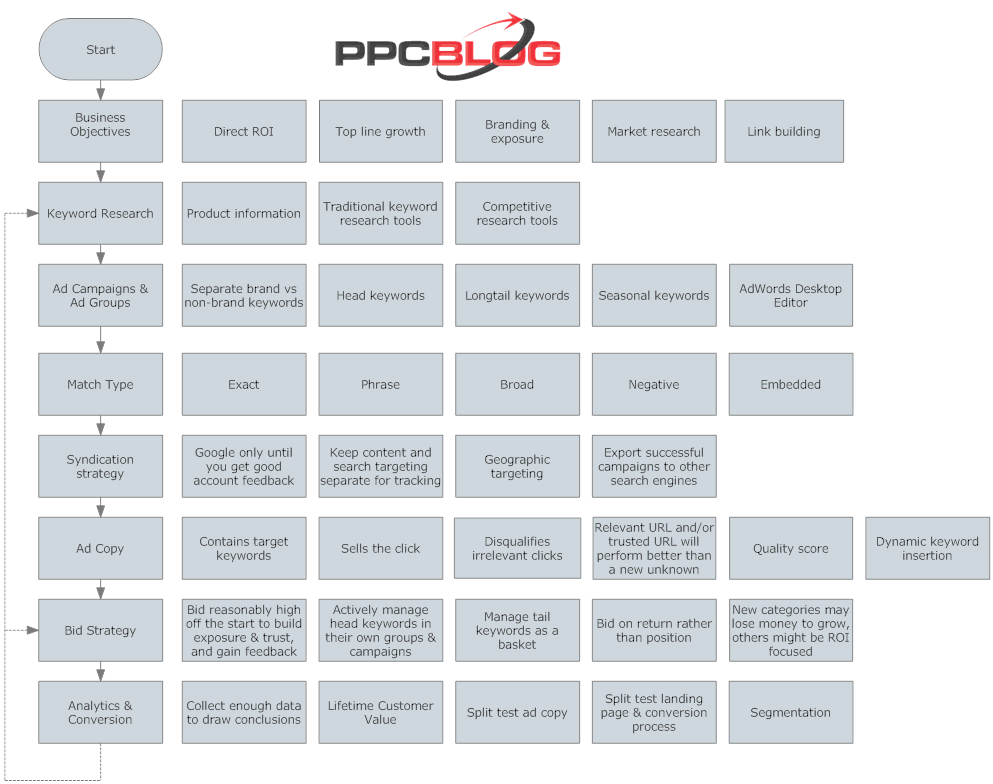
Simple But Effective PPC Flowchart
From PPC Blog : http://tools.ppcblog.com/flowchart/ppc-flowchart.gif
![]() |
| Not really sure why it's a GIF, but ok. |
This flowchart from PPC Blog does a pretty decent job of outlining the implementation and refinement of a Pay-Per-Click Campaign.
Left side is flow from top to bottom, right is purpose and details.
Roughly translates into:
- Start by defining Business Objectives and the expectations and needs from PPC advertising
- Do Keyword Research by tapping into available information and keyword tools
- Build initial Ad Campaigns & Groups based upon targeted demographics and relevant keyword groupings
- Define Match Type based upon range of relevant searches for targeted keywords
- Create Syndication Strategy for additional targeting methods and other search engines
- Write high quality Ad Copy to attract relevant attention and improve Quality Score
- Manage Bid Strategy based upon needs and budget
- Analyze your results, and use data to refine Keyword Research and Bid Strategy
This picture is a bit outdated, because it doesn't take into account Remarketing (targeting people who have already visited your site), but is still a solid flowchart.
Labels:
advertising,
adwords,
bid strategy,
campaigns,
flowchart,
google,
keywords,
picture,
ppc,
quality score,
tips
Tuesday, November 26, 2013
Brief History Digital Age Advertising and Modern Web Marketing
A Brief History of Advertising in the Digital Age and some Thoughts on Modern Web Marketing
After marketers realized SPAM didn't work (well some of them anyway), the next platform for battle was the web. But how to address this new dynamic audience? The first banner ad was from AT&T and essentially linked folks to museums all over the world (essentially demoing how the internet could narrow space and time). This ad had a whopping 44% click through rate, and for those of you who don't know, that's high, very high.
Originally, ads were sold with a suitcase. Sites had a set of inventory, and like traditional media businesses, that's how they sold. Yahoo, to this day, has an army of account managers gleefully cold calling the fortune 500 daily in an attempt to sell more space. If one had to articulate the difference between Yahoo and Google, it is a cultural difference. Yahoo was, and still is, a sales driven culture, whereas Google is all about the engineers. What do we know about most engineers? They don't like talking to peasants, and thus Yahoo sells with a briefcase and Google distributes through an online portal. If anyone asks you to articulate why Yahoo lost to Google even though Yahoo was first, it was because Google automated where Yahoo brute-forced with more salespeople. The moral is that payroll is always your highest cost.
So we're up to the point of automated ad acquisition on the Internet. People could buy ads, but then double-click came along and said, 'You can buy ads everywhere and control them!', which basically was an admission of the one true fact of online ads: Supply outpaces demand.
In online advertising, there is always a LOT more supply than demand. There are many more people trying to sell adspace than there are people that want to buy it. One might assume, naturally, that this would become a buyers market, but keyword based advertising is actually a seller's market. Adwords, for example, is really Google telling you how much you have to pay for an impression, and that doesn't reflect the underlying reality of our world. Again, supply > demand therefore the buyer should set the price. Even if you could buy based on audience or location and not keyword, you would still be paying for impressions that aren't actually valuable (people who don't have the faintest clue who you are will see your brand and that may or may not be valuable to you.
Well, if all of the search space is owned by Google, you sort of have to play ball right? That was true until the advent of retargeting.
Basically retargeting works like this:
- User hits your site
- User gets cookie'd
- Anywhere they go that is part of the ad network, an auction takes place
- The auction bidders are advertisers who bid based on the cookies a user has
- Some people bid on generic cookies like "user is 25-40 years old" or "user likes red sports cars" but retargeting is basically saying "I only want to bid on people that've already been to my website"
- Generic cookie folks are willing to pay a certain price for an impression if enough characteristics match up, but retargeting is always willing to pay the same price for the people who've been cookie'd
- So while the page is loading, hundreds (thousands?) of advertisers are bidding on the ad you'll see
- One the bidding is won, the ad is displayed
So, let's talk, from a high level, about where to use the basic ad forms:
PPC: Pay per click ads are cool for branding. If you want people to see your brand, they work great, but they're basically spray and pray. If you're just starting out, don't go through the main channels like adwords as you'll burn your budget rather quickly. Consider alternative channels like Reddit or Stumbleupon as sources of relatively cheap traffic. I don't see a lot of value in PPC today.
Banner Ads: Private placement banner ads are still good, but you have to be tactical about purchasing them because they're not usually cheap. You can use an aggregation service if you have the volume, but this should be, IMHO, surgical. For example, at 2600hz, we've considered purchasing banner ad space on multiple Sysadmin blogs through direct relationships with their authors.
Retargeting: In my humble opinion, this is the only form of online advertising still worth a damn. You can follow people around the Internet, but only the people that already know who you are. It's glorious. The downside? Retargeting will eat your budget and fast. Remember the supply and demand problem? Because retargeting only cares that your customer went to your site, the places they display ads are different than say adwords which only displays on google searches. If you use retargeting, your customers will see your logo and they will see it all over the place.
My prescription, for Enterprise SaaS startups is to pour on the Retargeting and leverage a few surgical banner ads. I don't believe you should be using any sort of paid online advertising if your customer lifetime value is less than $50 as you'll be unlikely to ever break even. I believe online advertising can be a profitable channel for your business, but only if you are judicious about its usage. I've seen so many people burn through cash, it's crazy.
Remember also, cost per click is a relative term. If you relate it to your end goal, it's more reasonable. if you customer is worth $50, it's hard to justify paying more than $.50 per click, but if they have a value of $500, a CPC of $1.50 or even $4.00 could be justifiable. It all comes back to the business use case.
Do you have questions and PPC or other ad units? Drop'em in the comments below and I'll do everything I can to answer.
Curious about the history of ads? This is where I got most of my info: http://www.adpushup.com/blog/the-history-of-online-advertising/
~~~~~~~~~~~~~~~~~~~~~~~~~~~~~~~~~
Rabbit notes:
I do like the fact that he points out trying to use Adwords without knowing the ins and outs will have you burn through cash quickly, and suggests considering interest-targeted channels like Reddit Ads and StumbleUpon's Paid Discovery.
A side note about Reddit ads - while there are a lot of factors that influence the success of Reddit ads, it is worth mentioning that it is one of the few ad networks that are generally whitelisted and may reach users who use Ad-blocking software - something to consider if the audience you want to reach is tech-savvy.
Labels:
advertising,
adwords,
banner ads,
digital,
history,
marketing,
reddit,
retargeting,
spam,
startup,
stumbleupon
Monday, November 25, 2013
Remember: SEO, SEM, and SMM are 3 Different Things
This article is here to make you a better client for any Web Marketing firm or freelancer.
Too often do I see people assuming SEO is everything about the website's marketing efforts, and are confused that there are different costs associated with it. To be fair, nobody outside SEO experts cares about the difference between SEO and SMM, but as a client, knows the difference, you will likely prevent frustrating the person managing your website's marketing efforts.
SEO: Search Engine Optimization
Proper page structure, header tags, meta and alt tags, backlinks - all things to allow search engines to better browse your site and determine the quality of your page
SMM: Social Media Marketing
Using Facebook, Twitter, Google+, and other social platforms to build trust and as a PR interface
SEM: Search Engine Marketing
Some view this as the same as SEO, but I place Adwords Pay-Per-Click advertising and the like under this label
Just for the record, those three things are tied together which is why so many service companies offer them all. Don't be stupid and deny they aren't directly related, as in doing one is doing another as well.
Web design and SEO go hand-in-hand. They're not the same thing but there's a ton of overlap.
I can't tell you how many times I was approached to get a site into the search engines that had image menus, javascript links, dynamic content, a complete lack of h1, h2, etc, and even just things like overly complex page structure, or too much on one page. In terms of actually differentiating, it's arguable that you can differentiate those simply by pointing out the type of contract involved:
Finally, I always advise moving on to SEM/PPC advertising AFTER getting the SEO and SMM down. The reasoning is simple: Adwords takes your Page Quality into account when determining what your bid and subsequent ranking will be. Without the SEO and SMM, you would have to pay more for the same keywords.
Hope that helps, and best of luck to you and your website!
Too often do I see people assuming SEO is everything about the website's marketing efforts, and are confused that there are different costs associated with it. To be fair, nobody outside SEO experts cares about the difference between SEO and SMM, but as a client, knows the difference, you will likely prevent frustrating the person managing your website's marketing efforts.
SEO: Search Engine Optimization
Proper page structure, header tags, meta and alt tags, backlinks - all things to allow search engines to better browse your site and determine the quality of your page
SMM: Social Media Marketing
Using Facebook, Twitter, Google+, and other social platforms to build trust and as a PR interface
SEM: Search Engine Marketing
Some view this as the same as SEO, but I place Adwords Pay-Per-Click advertising and the like under this label
Just for the record, those three things are tied together which is why so many service companies offer them all. Don't be stupid and deny they aren't directly related, as in doing one is doing another as well.
Web design and SEO go hand-in-hand. They're not the same thing but there's a ton of overlap.
I can't tell you how many times I was approached to get a site into the search engines that had image menus, javascript links, dynamic content, a complete lack of h1, h2, etc, and even just things like overly complex page structure, or too much on one page. In terms of actually differentiating, it's arguable that you can differentiate those simply by pointing out the type of contract involved:
- Web site design is a fixed-task type contract. "Build a website and stop."
- SEO is a long-term ongoing engagement.
Finally, I always advise moving on to SEM/PPC advertising AFTER getting the SEO and SMM down. The reasoning is simple: Adwords takes your Page Quality into account when determining what your bid and subsequent ranking will be. Without the SEO and SMM, you would have to pay more for the same keywords.
Hope that helps, and best of luck to you and your website!
Subscribe to:
Posts (Atom)